
A Dark Vector Cognition product

PDF to Markdown

PDF in. Markdown out.

Turn a PDF into Markdown for your next chat or script.

PDF · note 5
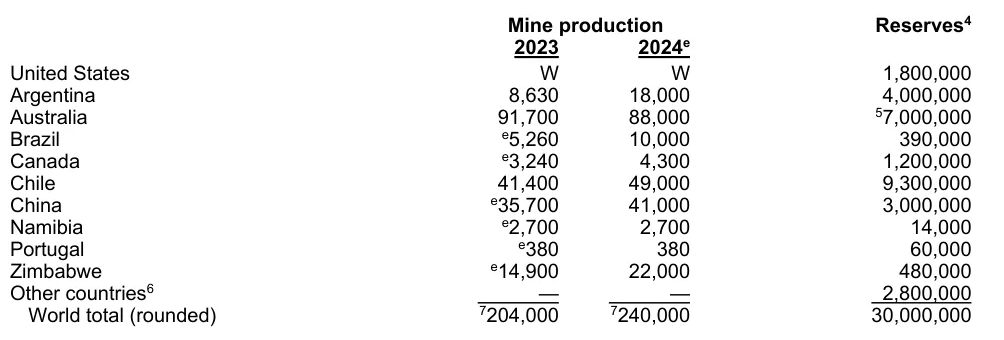
The source PDF, page 2: the World Mine Production and Reserves table, where Australia's reserves read 7,000,000 with a superscript 5.
||**Mine pro**|**duction**|**Reserves**<sup>**4**</sup>|
|---|---|---|---|
||<br>**2023**|<br>**2024**<sup>**e**</sup>||
|United States|W|W|1,800,000|
|Argentina|8,630|18,000|4,000,000|
|<br>Australia|91,700|88,000|57,000,000|
|Brazil|e5,260|10,000|390,000|
|Canada|e3,240|4,300|1,200,000|
|Chile|41,400|49,000|9,300,000|
|China|e35,700|41,000|3,000,000|
|Namibia|e2,700|2,700|14,000|
|Portugal|e380|380|60,000|
|<br>Zimbabwe|e14,900|22,000|480,000|
|Other countries<sup>6</sup>|—|—|2,800,000|
|World total (rounded)|7204,000|7240,000|30,000,000|
Markdown · slips marked
Source PDF, page 2pdfmd's Markdown, unedited, slips marked

md = Markdown. Also Model-ready Data, Memory-only Data, Measured and Documented and Minimum Dollars, plus Machine-read Documents for English scans. Next on the chart: pdf, M.D., a free file checkup.

TablesMarkdown structure
ScansEnglish OCR
MCPIn your assistant
APIIn your script

Precomputed sample · nothing is uploaded to show it

Chart notes

mcs2025-lithium.pdf2 pages3 tables9,274 charactersconverted 24 September 2026, parser 0.1.0 (pymupdf4llm 1.28.2, no OCR)source: U.S. Geological Survey, public domainnotes AI-reviewed against the source PDF, sample only, no human sign-off

Page 1 of the source PDF
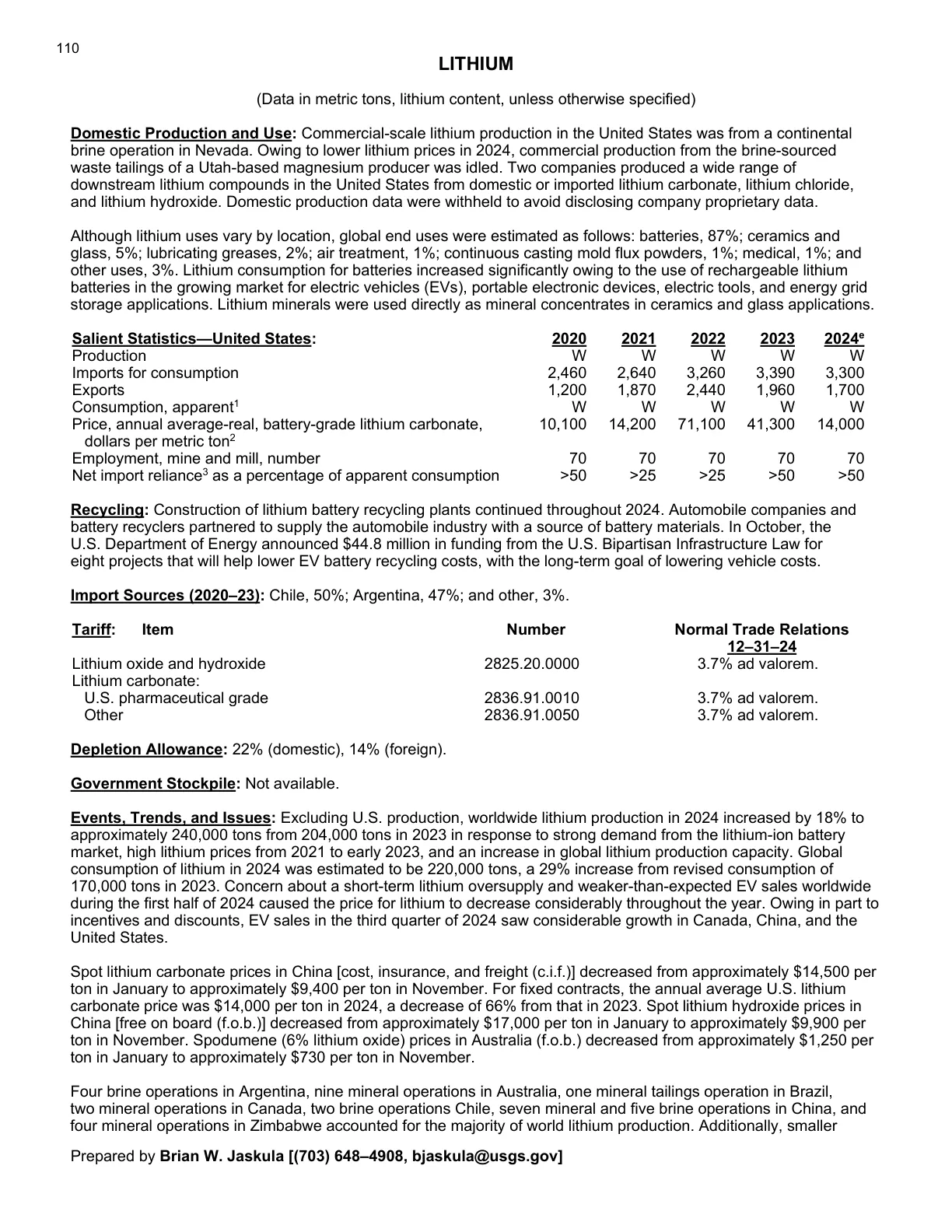
The source, page 1 of 2. USGS, January 2025. Public domain.

110 page 1 of the PDF starts here; its page number came through as text

LITHIUM

(Data in metric tons, lithium content, unless otherwise specified)

Domestic Production and Use: Commercial-scale lithium production in the United States was from a continental brine operation in Nevada. Owing to lower lithium prices in 2024, commercial production from the brine-sourced waste tailings of a Utah-based magnesium producer was idled. Two companies produced a wide range of downstream lithium compounds in the United States from domestic or imported lithium carbonate, lithium chloride, and lithium hydroxide. Domestic production data were withheld to avoid disclosing company proprietary data.

Although lithium uses vary by location, global end uses were estimated as follows: batteries, 87%; ceramics and glass, 5%; lubricating greases, 2%; air treatment, 1%; continuous casting mold flux powders, 1%; medical, 1%; and other uses, 3%. Lithium consumption for batteries increased significantly owing to the use of rechargeable lithium batteries in the growing market for electric vehicles (EVs), portable electronic devices, electric tools, and energy grid storage applications. Lithium minerals were used directly as mineral concentrates in ceramics and glass applications.

Salient Statistics—United States:20202021202220232024e
ProductionWWWWW
Imports for consumption2,4602,6403,2603,3903,300
Exports
1,2001,8702,4401,9601,700
Consumption, apparent1WWWWW
Price, annual average-real, battery-grade lithium carbonate,
10,10014,20071,10041,30014,000
dollars per metric ton2
Employment, mine and mill, number7070707070
Net import reliance3as a percentage of apparent consumption>50>25>25>50>50

Recycling: Construction of lithium battery recycling plants continued throughout 2024. Automobile companies and battery recyclers partnered to supply the automobile industry with a source of battery materials. In October, the U.S. Department of Energy announced $44.8 million in funding from the U.S. Bipartisan Infrastructure Law for eight projects that will help lower EV battery recycling costs, with the long-term goal of lowering vehicle costs.

Import Sources (2020–23): Chile, 50%; Argentina, 47%; and other, 3%.

Read the whole sample, with its Markdown source, Copy and Download.

In your assistant

Use it from your assistant

Claude, Cursor, VS Code or ChatGPT can call pdfmd inside the chat: give it a public PDF link, get the Markdown back. Same free allowance as the API, 25 pages a day, no key.

Add to ClaudeAdd to CursorAdd to VS Code

  • Claude Codeclaude mcp add --transport http pdfmd https://pdfmd.dev/mcp
  • Codexcodex mcp add pdfmd --url https://pdfmd.dev/mcp

Claude opens its Add custom connector dialog with the name and URL filled in: check both, continue, and choose no sign-in. ChatGPT has no install link: turn on developer mode (Settings, Apps, Advanced settings; available on some paid plans), then create an app with https://pdfmd.dev/mcp and no authentication.

Your next step

Choose your door.

The web tool

Walk-in

Free

20 files a day. No account.

Up to 50 pages each and 200 pages a day.

Convert a PDF
The monthly API plan

Resident

$8.90 a month

10,000 pages a month.

$0.89 per 1,000 pages · launch price, limited time

All plans

Keep the structure

Why this and not “save as text”

Plain text extraction loses structure: tables collapse into word soup and headings disappear, so a model cannot tell a footnote from a finding. Markdown keeps the hierarchy and the tables, which is what retrieval and summarization need. The same converter is an API: POST /api/v1/convert, 25 pages a day free, and plans metered in pages. API docs.

Guides

How it compares

Six public domain PDFs through pdfmd.dev, Marker, Docling and plain PyMuPDF, timed and scored against reference tables that an AI model checked against the source, with no human sign-off yet. The benchmark, including where pdfmd loses.